
In January 1846, a young Royal Navy stoker named John Shaw Torrington died in the Arctic. He was likely no older than 20. His death made him the first known fatality of one of history’s most studied naval disasters — the lost Franklin Expedition.
During his lifetime, Torrington was not famous. He was not an officer or an explorer. He was a working-class young man doing a technical job aboard a ship. But more than a century after his death, his story would reach people all over the world.
This article covers who Torrington was, what he did aboard HMS Terror, what is known about his family, how he died, and why a 1984 scientific exhumation made his face one of the most recognizable images connected to the Franklin Expedition.
Who Was John Shaw Torrington?
John Shaw Torrington was born around 1825 or 1826, most likely in Manchester, England. The exact birth date is uncertain — sources differ, and available records do not fully agree on the year.
He was not a nobleman, an officer, or a public figure. He came from a working-class background and joined the Royal Navy as a technical crew member. During his lifetime, there was nothing about him that would have drawn public attention.
Limited biographical evidence survives. Researchers have pieced together fragments of his identity through parish records and naval documents, but a full personal history simply does not exist in the surviving record. His posthumous recognition came entirely from the expedition he joined — and from what happened to his remains long after he was buried.
His Role Aboard HMS Terror
Torrington served as a leading stoker aboard HMS Terror, one of the two Royal Navy ships assigned to the Franklin Expedition. His counterpart vessel was HMS Erebus.
As a stoker, his job was to operate and maintain the ship’s coal-fired steam machinery. This was physically demanding, skilled technical work. It also placed him well down the ship’s hierarchy — far from the officers and commanders who tend to dominate popular accounts of the expedition.
Naval records suggest he was around 19 years old when he joined the expedition in 1845. He was young, experienced with ship machinery, and assigned to one of the most ambitious Arctic voyages Britain had ever mounted.
The Franklin Expedition and What It Set Out to Do
The expedition left Britain in May 1845 under the command of Sir John Franklin. Its primary goal was to navigate the Northwest Passage — a sea route through the Canadian Arctic connecting the Atlantic and Pacific Oceans. The mission also included geographic and scientific observations.
Both ships became trapped in Arctic ice, and none of the approximately 129 crew members survived. The full story of what happened took decades to reconstruct and is still not entirely settled.
Torrington died during the expedition’s first winter, before the ships pushed deeper into the Arctic. That timing matters. His death is a marker of just how early things began to go wrong — before the worst of the crew’s hardships had even begun.
His Family Background and the Evidence That Survives
Genealogical research has identified his parents as William Torrington and Sarah Shaw Torrington. A baptismal record from Manchester, dated December 10, 1826, lists both John Shaw Torrington and a sister named Esther Shaw Torrington.
This record is useful but not without complications. Naval records suggest Torrington was 19 when he joined the expedition in 1845, which would place his birth closer to 1825 or early 1826 — not December 1826. A baptism date and a birth date are not the same thing, which partly explains the gap. Babies were sometimes baptized weeks or months after birth.
Researchers have also compared the Manchester baptismal record against other possible records, including a separate Norfolk record, and acknowledge that matching names across historical documents from this period is an imprecise process.
The most honest way to read this evidence is as a strong but not fully verified reconstruction of his family identity. It is the best available picture — not a complete one.
Death, Burial, and the Graves on Beechey Island
John Shaw Torrington died on January 1, 1846. He is generally identified as the first known fatality of the Franklin Expedition. He was buried on Beechey Island, in what is now the Canadian Arctic.
Two other expedition members — John Hartnell and William Braine — were buried nearby. The three graves became some of the most important physical evidence in later efforts to understand what happened to the expedition. They were among the first hard clues researchers could examine directly.
The graves were marked and remained undisturbed in the Arctic permafrost for well over a century. That frozen ground would turn out to be significant in ways no one at the time could have anticipated.
The 1984 Exhumation and Why It Changed Everything
In 1984, a team of researchers led by Canadian anthropologist Owen Beattie traveled to Beechey Island to exhume Torrington’s remains. The purpose was scientific: to study the physical evidence of how expedition members lived, what they ate, what they were exposed to, and what may have contributed to their deaths.
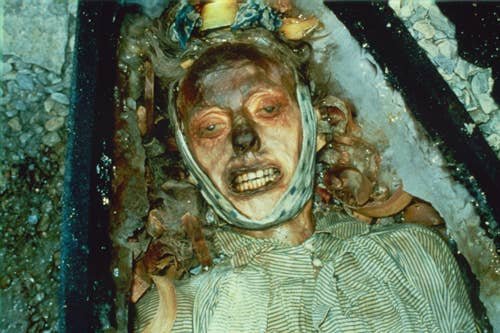
What they found was remarkable. Torrington’s body had been preserved by the Arctic permafrost to an unusual degree. His features, clothing, and physical condition were largely intact after nearly 140 years.
Photographs taken during the exhumation were eventually published and circulated widely. The image of Torrington’s preserved face — still recognizable as a young man — gave the public something they had never had before: a direct visual connection to one of history’s most mysterious naval disasters.
He became, in a very real sense, the human face of the Franklin Expedition. Not because of his rank or his deeds, but because his preserved appearance made the story suddenly personal and immediate in a way that maps, ship logs, and officer portraits never quite managed.
What His Story Reveals About Ordinary Crew Members?
Popular accounts of the Franklin Expedition tend to focus on Sir John Franklin and the officers. Their names, decisions, and fates appear in books, documentaries, and historical records far more often than the names of the sailors and technical workers who made the voyage possible.
Torrington’s story is a reminder that the expedition was crewed by roughly 129 men, most of them working-class and relatively young. Their lives are less thoroughly documented. Parish registers, naval muster books, and allotment books provide fragments — but building a full picture requires careful, often inconclusive work.
For anyone interested in historical research or genealogy, Torrington’s case is a useful example of how much can be reconstructed from incomplete records, and how honest researchers must be about the limits of what they know. If you enjoy exploring that kind of careful, evidence-based thinking, Honest Business Tips applies a similar approach to practical everyday topics.
A Note on Name Confusion
It is worth addressing one point of potential confusion directly. John Torrington the historical figure is sometimes mixed up in searches with John Thorrington — a modern American soccer player and sports executive. The spelling is different, and the two are entirely unrelated. There is no documented family connection between them.
Similarly, any researcher encountering the Torrington surname in other contexts should not assume a connection to the Franklin Expedition sailor without documentary evidence. A shared surname is not proof of kinship.
Why John Torrington Still Matters?
John Shaw Torrington lived a short life that left almost no footprint in the historical record. He was not famous, not decorated, and not in command of anything. He was a teenager who took a job on a ship and died before the voyage had barely begun.
What makes his story worth telling is exactly that ordinariness. He represents the many young men whose names appear in the margins of great historical events — people whose contributions and fates rarely receive the same attention as those above them in rank.
Through the work of researchers, archaeologists, and genealogists, a partial picture has emerged. It is incomplete, carefully assembled from baptismal records, naval documents, and the physical evidence of the grave itself. But it is enough to give a real person back to history — one who deserves to be remembered as more than simply a preserved body or an atmospheric detail in someone else’s story.
He was John Shaw Torrington, leading stoker, HMS Terror, likely born in Manchester around 1825 or 1826. He died on the first day of 1846, in the Arctic, at the very beginning of what would become one of the most studied disasters in naval history. He was probably 20 years old.
Also Read: